and I just can't even describe how great it was. Greening of Detroit, the place that I'll be working for this year, is just pretty amazing and I could go on and on about it, but I will just try and describe a little bit about why Detroit in particular really needs the sort of work that they do with Urban Agriculture.
First let's just talk about how bad the food system of Detroit is. 56% of Detroiters get their groceries from liquor stores. Places with only processed food available in general, where there is no customer service, where there is plate glass between you and the person selling you the food and where your money is most likely going to leave the community. This percentage is even higher for people on food stamps, mostly because the neighborhoods with the worst grocery store availability are the poorest. The sort of food you can buy in these stores not only is unhealthy and thus adds to both adult and childhood obesity problems, but also a sense of just generally depression and low self esteem.
Detroit in general is not a place where people usually feel good about the place they live. Detroit has a bad rap and has been going down hill in many ways for a long time. The area of the city is larger than Manhattan, San Francisco and Boston COMBINED. There used to be 2 million people living in the city and now 730,000 folks live here, and that is still dropping.
When things get bad like they are in Detroit people tend to turn on themselves and act in self abusive ways and just try to take what they can get from life. Luckily Detroit has a history of using farming and gardening to pick itself up. In what may be the first example of urban gardening Mayor Pingree during the depression of 1890 gave empty plots to hungry people. He even sold one of his own horses to buy them seeds. This became a model for many other cities and was repeated with Thrift Gardens during the Great Depression and Victory Gardens during World War 2.
There was also a great program here during the 1970s called Farm-A-Lot which I'll try and learn more about and write about here later. The point is that Detroit has a history of using agriculture as a way of picking itself up during hard times, which with 11.6% unemployment this certainly is.
And there's plenty of space for it. There are about 50,000 PUBLICLY owned lots in Detroit with zero structures on them. Note that this doesn't even begin to address all the privately owned lots or lots with structures that should probably be taken down. There are about 10-14 lots per acre so we're talking about 5,000 acres of potential farm land. A study found that with just that publicly held land Detroit could grow about 76% of its current consumption of vegetables and 42% of its fruit. That is amazing potential to change the way Detroiters eat and live. Truly an inspiring work to be involved with.
Thursday, September 15, 2011


Wednesday, September 14, 2011
Wildlife in the city
Moving from the farm to the city is different in about as many ways as you'd imagine. While the animal life might be different in many ways, it is not totally lacking. Today in the dirt in our garden I saw a millipede, a worm and a pill bug. There are also some aphids on our broccoli which I need to deal with.
There are more squirrels around then I care to count, making it unsafe for me to leave peaches on the porch, I discovered. There were also some bats flying around eating bugs last night. Birds as well, that I hear sometimes, but I haven't seen many yet. Maybe a bird feeder this winter? Probably would just be a squirrel feeder.
There are more squirrels around then I care to count, making it unsafe for me to leave peaches on the porch, I discovered. There were also some bats flying around eating bugs last night. Birds as well, that I hear sometimes, but I haven't seen many yet. Maybe a bird feeder this winter? Probably would just be a squirrel feeder.
Tuesday, September 13, 2011
Dumb cop
Cop: Hey, what do you think you're doing?
Me: I'm making a left turn
Cop: You need to get out of there
Me: I'm making a left turn (thinking I hadn't been heard)
Cop: Well you can't do it there. You need to get in the cross walk (I'm in the left turn lane)
Me: I was taught you're supposed to bike with the flow of traffic
Cop: Well not here
Me: *Make left turn*
Here is the relevant bit of law:
257.660a Operation of bicycle upon highway or street; riding close to right-hand curb or edge of roadway; exceptions.A person operating a bicycle upon a highway or street at less than the existing speed of traffic shall ride as close as practicable to the right-hand curb or edge of the roadway except as follows:
(a) When overtaking and passing another bicycle or any other vehicle proceeding in the same direction.
(b) When preparing to turn left.
(c) When conditions make the right-hand edge of the roadway unsafe or reasonably unusable by bicycles, including, but not limited to, surface hazards, an uneven roadway surface, drain openings, debris, parked or moving vehicles or bicycles, pedestrians, animals, or other obstacles, or if the lane is too narrow to permit a vehicle to safely overtake and pass a bicycle.
(d) When operating a bicycle in a lane in which the traffic is turning right but the individual intends to go straight through the intersection.
(e) When operating a bicycle upon a 1-way highway or street that has 2 or more marked traffic lanes, in which case the individual may ride as near the left-hand curb or edge of that roadway as practicable.
From m-bike.org
Here is the relevant bit of logic:
Bikes should ride with the flow of traffic. On sidewalks they interfere with pedestrian traffic and if you use the crosswalks you will end up at least temporarily riding against the flow of traffic, which makes everyone nervous. Out in the left turn lane you are visible and it is clear what you are going to do next make a left turn and as long as you follow traffic laws everyone should be fine.
Me: I'm making a left turn
Cop: You need to get out of there
Me: I'm making a left turn (thinking I hadn't been heard)
Cop: Well you can't do it there. You need to get in the cross walk (I'm in the left turn lane)
Me: I was taught you're supposed to bike with the flow of traffic
Cop: Well not here
Me: *Make left turn*
Here is the relevant bit of law:
257.660a Operation of bicycle upon highway or street; riding close to right-hand curb or edge of roadway; exceptions.A person operating a bicycle upon a highway or street at less than the existing speed of traffic shall ride as close as practicable to the right-hand curb or edge of the roadway except as follows:
(a) When overtaking and passing another bicycle or any other vehicle proceeding in the same direction.
(b) When preparing to turn left.
(c) When conditions make the right-hand edge of the roadway unsafe or reasonably unusable by bicycles, including, but not limited to, surface hazards, an uneven roadway surface, drain openings, debris, parked or moving vehicles or bicycles, pedestrians, animals, or other obstacles, or if the lane is too narrow to permit a vehicle to safely overtake and pass a bicycle.
(d) When operating a bicycle in a lane in which the traffic is turning right but the individual intends to go straight through the intersection.
(e) When operating a bicycle upon a 1-way highway or street that has 2 or more marked traffic lanes, in which case the individual may ride as near the left-hand curb or edge of that roadway as practicable.
From m-bike.org
Here is the relevant bit of logic:
Bikes should ride with the flow of traffic. On sidewalks they interfere with pedestrian traffic and if you use the crosswalks you will end up at least temporarily riding against the flow of traffic, which makes everyone nervous. Out in the left turn lane you are visible and it is clear what you are going to do next make a left turn and as long as you follow traffic laws everyone should be fine.
Just passing this along:
I really liked the last bit of this article:
My nominees for some to-be-agreed-upon principles: cars and trucks are the most dangerous things on the road and should yield to pedestrians and cyclists.
Cyclists are the next most dangerous things on the road, and should yield to pedestrians and watch out for cars and trucks.
Pedestrians are the most vulnerable things and so should be very aware of cyclists, cars and trucks.
To ride a bicycle without brakes is a declaration of reckless indifference for one's own life and so is evidence of reckless indifference for one's fellow citizens' safety.
Everyone should always imagine, while being a pedestrian, cyclist, or driver, what the people doing the other two things are reasonably likely to think/assume/act on, and act accordingly.
We all want to get where we're going in one piece. No one wants to be talking to the cops, the insurance company, or the newspapers. And one fundamental fact of living in cities is having to deal with other people. Lots of them. So, can we all just get along?
Read the whole thing here.
My nominees for some to-be-agreed-upon principles: cars and trucks are the most dangerous things on the road and should yield to pedestrians and cyclists.
Cyclists are the next most dangerous things on the road, and should yield to pedestrians and watch out for cars and trucks.
Pedestrians are the most vulnerable things and so should be very aware of cyclists, cars and trucks.
To ride a bicycle without brakes is a declaration of reckless indifference for one's own life and so is evidence of reckless indifference for one's fellow citizens' safety.
Everyone should always imagine, while being a pedestrian, cyclist, or driver, what the people doing the other two things are reasonably likely to think/assume/act on, and act accordingly.
We all want to get where we're going in one piece. No one wants to be talking to the cops, the insurance company, or the newspapers. And one fundamental fact of living in cities is having to deal with other people. Lots of them. So, can we all just get along?
Read the whole thing here.
Monday, September 12, 2011
Welcome to Detroit
After basically abandoning this blog since I returned from Nicaragua I have decided to try to revive it. I just moved to Detroit and already feel like there is lots to say. I envision to be a little bit observations about Detroit, a little urban homesteader, a little food blog and little bike blog.
So let's start with bike. I've been for those of you who may not know, my bike looks like this:

It is a Surly Big Dummy with an Xtracycle rack system on the rear. It is pretty much the best thing ever. I use it for touring and lots of around town riding. I've been a bike commuter for years, but when I worked on the farm in Walla Walla still had to use a pick up truck often for farm errands. No more though. Now that I am living the city life in Detroit it is a different story though. I have zero car and am riding in a completely different environment.
So far the motor city has been good to my bike and I. There is a nice bike lane on my street and I get to go over a pedestrian bridge on the way to work (and the bridge and its street are named after my last name, obviously they knew I was coming). The drivers have been better than I expected as well. Only got honked at a couple times for riding with traffic and many folks went out of their way to give me extra room.
Of course, with a bike like mine I get a lot of comments. Here are some choice ones:
- Guy on a Harley with his girlfriend on the back rode at 10 mph with me for 2 blocks to talk to me about the bike and the possibilities for carrying people on the back.
- Guy asked me if it was homemade. I said I wished.
- Guy in front of CADILLAC PLACE in the MOTOR CITY told me that my bike was "A Cadillac on 2 wheels"
- Guy at the bus stop jokingly asked me for a ride, I turned around and told him I could take him down the block. He said he had to go farther but said he'd catch me some other time.
So let's start with bike. I've been for those of you who may not know, my bike looks like this:
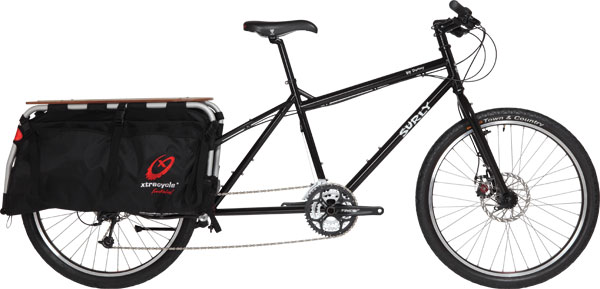
It is a Surly Big Dummy with an Xtracycle rack system on the rear. It is pretty much the best thing ever. I use it for touring and lots of around town riding. I've been a bike commuter for years, but when I worked on the farm in Walla Walla still had to use a pick up truck often for farm errands. No more though. Now that I am living the city life in Detroit it is a different story though. I have zero car and am riding in a completely different environment.
So far the motor city has been good to my bike and I. There is a nice bike lane on my street and I get to go over a pedestrian bridge on the way to work (and the bridge and its street are named after my last name, obviously they knew I was coming). The drivers have been better than I expected as well. Only got honked at a couple times for riding with traffic and many folks went out of their way to give me extra room.
Of course, with a bike like mine I get a lot of comments. Here are some choice ones:
- Guy on a Harley with his girlfriend on the back rode at 10 mph with me for 2 blocks to talk to me about the bike and the possibilities for carrying people on the back.
- Guy asked me if it was homemade. I said I wished.
- Guy in front of CADILLAC PLACE in the MOTOR CITY told me that my bike was "A Cadillac on 2 wheels"
- Guy at the bus stop jokingly asked me for a ride, I turned around and told him I could take him down the block. He said he had to go farther but said he'd catch me some other time.
Saturday, April 17, 2010
Food Webs
It is that early morning time, when the dew still hide on the west side of grass blades and the birds are still the dominant sound in the air. This is the time of cutting flowers and picking spinach and checking irrigation lines. This is the time for a cup of tea and a deep brearth of air. This is the time that makes farming the best job on earth.
That time before most people are working is the peak of your day, your rush hour. Before the heat begins to rise and sun to beat down you have to move all the cut flowers into buckets of cold water and coolers. The leafy greens must be picked and plunged into cold water and the peas hidden in buckets placed in the shade. The quality and keeping power of your wares relies on your ability to beat the sun and work with water shade and breeze to preserve freshness and moisture. At the same time you are filled with business and eagerness, the rest of the world is only barely stirring, thinking not of heat and crisp heads of lettuce, but of coffee and starting car engines.
This fails to capture the reason that I love the morning, and also my job though. Perhaps it is that the morning is new and filled with energy. I will never feel so good for the rest of the day as I do the moments after finishing morning stretches and shaking the sleep from my limbs. Maybe it is the anticipation of what is to come, the Farmers Market oohs and aahs at the bouquets, or the crisp salads yet to be cooked. There certainly is much satisfaction in the mother who buys your spinach to make baby food. For the restuaranters, co-op and families that I well to, there is certainly an element of trust, in purity, nutrition and quality, that fills my work with a certain meaningfulness and purpose.
But what is sometimes perhaps even more satisfying is seeing the land that I work, rather that what most people think of as a farmer's “finished product”. Undoubtedly part of the reason that I so love the morning is that I am not the only part of the farm that is feeling most lively first thing in the morning. Beetles scuttle from bark chip to fallen leaf. Pill bugs look for a place to stay wet through the day. Bees buzz happily about my fingers as I cut the flooms that they are hurriedly harvesting from. Robins, starlings, storks and numerous other birds flit in the air, and quails running out of the brush pile as I walk by.
Being able to be a part of this piece of land, finding my livelihood among so many other livelihoods is really what makes the whole endeavor worth while. As farmer perhaps it is best to say that I am the bridge, between a human food web of restuarants grocery stores farmers markets and dinner plates and a wilder food web; of bird eat bug eat bug eat leaf.
Subscribe to:
Posts (Atom)

